

Two weeks' leave after a pregnancy loss before 24 weeks starts in April 2027, after a campaign led by Luton North MP Sarah Owen. It will be unpaid.
Anyone who loses a pregnancy before 24 weeks will have the right to two weeks off work from April 2027. The government confirmed the new entitlement on Tuesday 22 September. It follows a campaign led by Sarah Owen, the MP for Luton North, who tabled the amendment that put pregnancy loss into the Employment Rights Bill.
The leave will be unpaid. That is the part the campaign did not win.
Owen said on the day of the announcement that the change “matters to Luton North”, and that it would “finally recognise it as the bereavement that it is”. She was chair of the Commons Women and Equalities Committee until 1 September this year, and has been a Northern Ireland Office minister since 22 July.
What the new right actually gives you
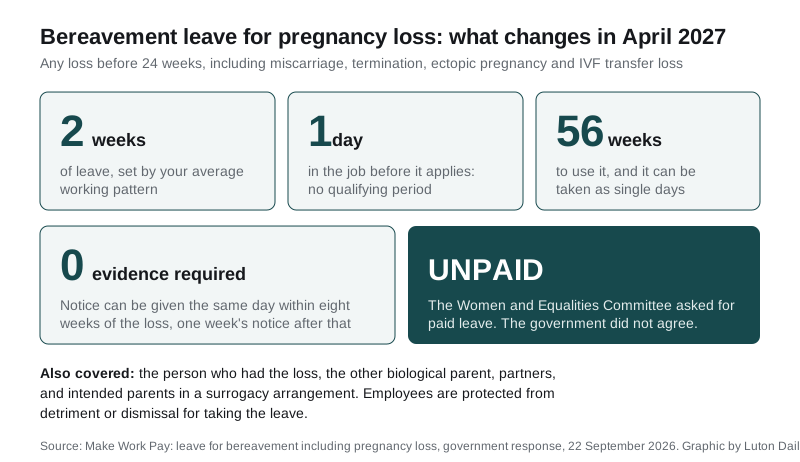
The government’s response to its consultation, published on 22 September, sets out the detail:
- up to two weeks of leave, calculated on your average working pattern
- from day one of a job, with no qualifying period
- taken any time within 56 weeks of the loss, and in separate single days rather than one block
- no evidence required, at all, at any point
- notice as soon as reasonably practicable, including the same day, if the leave falls in the first eight weeks after the loss; one week’s notice after that
- protection from detriment or dismissal for using the right
Losses before 24 weeks are covered whatever their form. The government response names miscarriage, terminations, ectopic pregnancy and IVF embryo transfer loss. The leave goes to the person who experienced the loss, the other biological parent, partners, and intended parents in a surrogacy arrangement.
The same legislation creates a separate day-one right to bereavement leave for employees who lose a spouse or partner, a parent, an adult child or a sibling. That list includes step, half, adoptive, kinship care and foster relationships, none of which currently carry any legal right to time off.
Unpaid is the argument that is left
The Women and Equalities Committee asked for paid leave. Its report Equality at work: Miscarriage and bereavement leave, published on 15 January 2025 under Owen’s chairmanship, concluded that “a period of paid leave should be available to all women and partners who experience a pre-24-week pregnancy loss”, and that “the case for a minimum standard in law is overwhelming”.
What arrives in April 2027 is two weeks unpaid.
Vicki Robinson, chief executive of Miscarriage UK, welcomed the announcement in the government’s own press release and then said plainly: “We still strongly believe bereavement leave should be paid, and we will continue to press for this through our Leave for Every Loss campaign.”
Money is not an abstraction here. The government’s own options assessment cites ONS research from 2025 finding that earnings after a miscarriage were still significantly lower five years on, an average total loss of £4,101. After an ectopic pregnancy the figure was £2,040 over three and a half years.
Why a Luton MP was the one carrying it
Owen has spoken about her own experience repeatedly, on the record, in her own words.
In her statement on the committee’s report she said: “I was not prepared for the shock of miscarrying at work during my first pregnancy. Like many women, I legally had to take sick leave. But I was grief stricken, not sick, harbouring a deep sense of loss.”
She returned to it in the Commons on 11 March 2025, when the government accepted the principle. “I experienced pregnancy loss while I was an MP,” she told MPs. At no point, she said, did colleagues tell her to get well soon. “They all said, ‘I’m sorry for your loss.’”
Her constituency website describes the campaign as one she ran long before she was elected, on the grounds that forcing women onto sick leave furthers “negative stigma around miscarriage as an ‘illness’”.
The numbers behind it
Miscarriage is not counted. The government’s options assessment says so directly: official statistics are not collected for miscarriages in the UK, and many happen before a woman knows she is pregnant.
Working from the best available estimates, it puts the number of pregnancies lost each year across the UK at around 565,000. That total is made up of:
- 250,000 miscarriages
- 269,000 terminations
- 35,000 IVF embryo transfer events that did not result in pregnancy
- 12,000 ectopic pregnancies, about 11 in every 1,000 pregnancies
Employer provision is patchy. The same assessment cites CIPD survey findings that just over a third of organisations, 36%, have any policy covering pregnancy loss or miscarriage. Only 9% have a standalone one.
The consultation ran from 23 October 2025 to 15 January 2026 and drew more than 1,900 responses. More than eight in ten employers who responded, and more than nine in ten business representative organisations, supported bereavement leave after the death of an immediate family member.
Locally, the reach is wide, because this is a day-one right rather than one you earn. There were about 109,000 employee jobs in Luton borough in 2024, according to the ONS Business Register and Employment Survey. Every one of those posts will carry the entitlement from the first morning.
What it means for you
Nothing changes yet. The right does not exist until secondary legislation is passed, which the government says will happen next year, for an April 2027 start. Until then your employer’s own policy is all there is, and there is a better than even chance it does not have one.
Two practical points for anyone in that position now.
First, ask for the policy in writing. The government’s own release says most employers already go further than the new minimum, including by paying, and the CIPD figures above show roughly a third have something written down. You cannot use a policy you have not seen.
Second, the existing statutory right already applies after 24 weeks. Parental Bereavement Leave covers a stillbirth after 24 weeks of pregnancy or the death of a child under 18. It is two weeks off, and it is paid for employees who meet the service and earnings conditions.
For care in Luton, the Early Pregnancy Clinic at Luton and Dunstable University Hospital sees pregnant women with pain or bleeding up to 20 weeks, and women at high risk of an ectopic pregnancy. It is appointment only on 01582 718179, with referrals through a GP, through A&E or by ringing the clinic. It runs weekday mornings from 8am, weekday afternoons from 2pm, and Saturday mornings from 8.30am.
Sources: Department for Business, Innovation, Science and Trade press release, 22 September 2026; Make Work Pay: leave for bereavement including pregnancy loss, consultation and government response; options assessment for new rights to unpaid bereavement leave including pregnancy loss; Women and Equalities Committee, Equality at work: Miscarriage and bereavement leave, 15 January 2025; Hansard, Employment Rights Bill, House of Commons, 11 March 2025; Sarah Owen MP, campaigns page and her own posts of 22 September 2026; UK Parliament Members API for committee and ministerial dates; ONS Business Register and Employment Survey, 2024, employee jobs in Luton (E06000032); Bedfordshire Hospitals NHS Foundation Trust.
Have your say