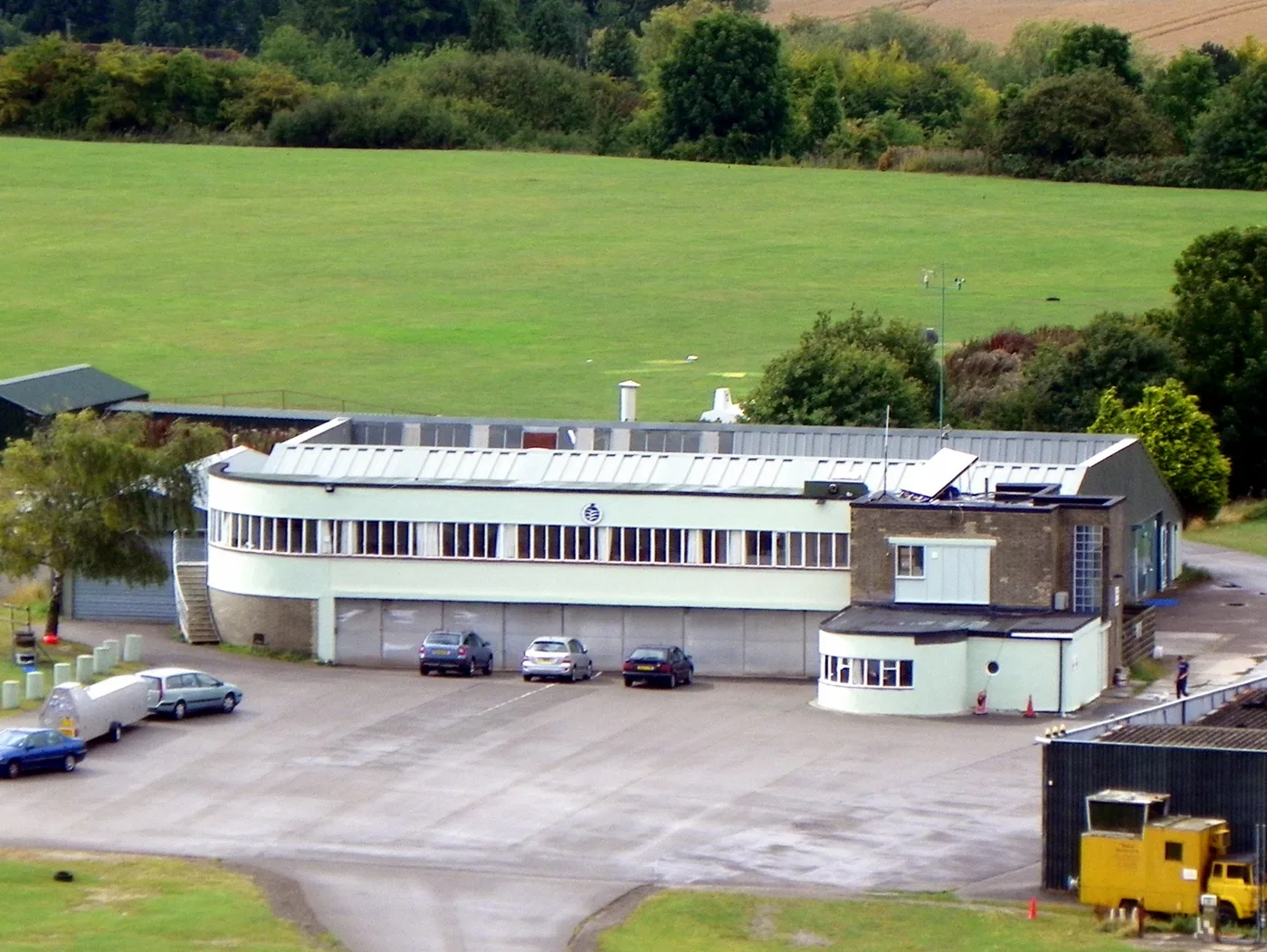

The Airprox Board found the glider 950ft below the Airbus and ruled out a collision risk. The 27 April encounter was over countryside near Leighton Buzzard.
An airline pilot reported a near miss with four gliders on the approach to Luton Airport, telling controllers they were at the same height as the aircraft. The UK Airprox Board has now ruled that there was no risk of collision, and that the closest glider was about 950ft below the Airbus A321.
The encounter happened at 1252Z on Monday 27 April, which was 1.52pm British Summer Time. The position given in the Board’s report is two nautical miles east of Leighton Buzzard, in Central Bedfordshire. That is roughly ten miles west of the airport, not over Luton itself.
The A321 was level at 5,000ft and downwind for runway 07. It was flying under instrument flight rules, under a radar control service from the Luton Final Director. The other aircraft was a Schleicher ASK21 training glider from the London Gliding Club at Dunstable Downs, with an instructor monitoring a student pilot.
At the closest point the Board recorded the two aircraft 0.8 nautical miles apart. It assigned the event Risk Category E, the category the Board uses for an incident that met the criteria for reporting but where “normal procedures, safety standards and parameters pertained”.
What the pilot reported
The A321 crew had briefed for the possibility of gliders before the approach, because the weather was good. They put the landing lights on below 10,000ft as a precaution.
About 15 nautical miles out on the approach aid, the first officer saw a glider off to the right at what looked like the same level. Looking out of the right-hand window, they counted at least three more.
The pilot’s account to the Board set out what worried them:
- the gliders were not transponding, so nothing showed on the aircraft’s collision warning system
- no alert of any kind was received
- the aircraft was in controlled airspace, under radar vectors, when the gliders appeared
- detection depended entirely on someone looking out of the window
The pilot assessed the risk of collision as medium. Their radio call was logged as “there is gliders at our, mayday, about four, one mile north of our position, five thousand feet”. The Board noted that nothing else said on the radio suggested a Mayday, and one member wondered whether the word had actually been “maybe”, mis-heard in transcription.
The crew also telephoned the tower afterwards. In that call the pilot said the glider was close enough that “I can even tell you the pilot was wearing an orange hat”.
What the recorders showed
That detail settled which glider it was. The Board’s secretariat recorded that the ASK21 pilot confirmed they had been wearing an orange hat on the flight.
The London Gliding Club pulled the secure flight recorder files from every glider that had launched from Dunstable that morning and was airborne at the time. Three were in the area. The ASK21 was the closest.
The glider carried three recording devices, including an Oudie N IGC certified to international standards for accuracy and security. The club’s figures were:
- 4,180ft above mean sea level on the calibrated secure recorder
- 4,200ft on an uncalibrated phone app carried as a cross-check
- 4,500ft is the base of Luton CTA 6, the controlled airspace the airliner was in
On those numbers the glider was 320ft below controlled airspace and never entered it. The Board agreed, concluding that the ASK21 pilot “had not flown inside the bounds of Luton CTA 6”.
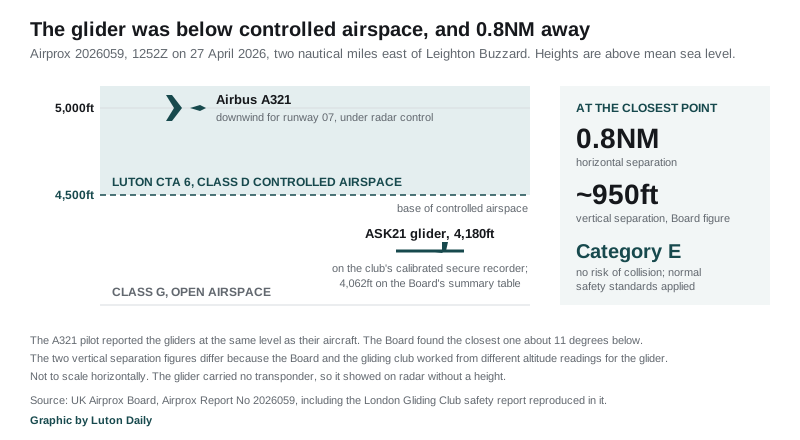
The Board’s own summary table records the glider slightly lower again, at 4,062ft, and puts the vertical separation at roughly 950ft. The club’s own calculation gives 820ft. The gap between the two figures follows from the two different altitude readings for the glider.
Neither pilot saw the other aircraft in time to act on it. The glider pilot, whose student was due to take their skills test, did not see the A321 at all. The Board found that see-and-avoid was not applicable here, and that neither aircraft’s electronic systems would have been expected to warn of the other.
As for why the pilot thought the glider was level with them, the Board calculated that it was about 11 degrees below the aircraft. It said that with no clear horizon, a declination of 11 degrees “may have been difficult to recognise”.
“Trust is not a safety barrier”
The sharpest material in the report is not from either pilot. It is from the Luton controller.
They described the moment the call came in. They could not believe what the pilot had said, and it took them a while to process. A second controller had just plugged in at the end of the watch. The two of them “looked at one another in disbelief”.
The controller then turned the following arrivals away from the area, and the Board commended them for it. Their written comments went further:
- gliders operate without radios or transponders just over half a mile north of the runway 07 approach
- on radar, controllers cannot tell a glider flying under the agreement from one that should not be there
- controllers have no view of a glider’s altitude at all
- flight crews in Class D airspace expect controllers to know where traffic is, and here they did not
“They are reliant on the crews seeing them, assuming they can and will,” the controller said, adding that the workload on approach is high, “so see-and-avoid cannot be the only line of defence”. On the agreement with the gliding club, they wrote: “Trust is not a safety barrier.”
The controller said the report from the crew had shaken them, and that “something needs to be done to aid the safe integration of gliding traffic if they are to operate so close a busy London airport”.
How Luton shares its airspace with the gliders
Dunstable Downs sits about seven nautical miles west of the airport, wholly inside the Class D airspace around Luton. The two operations are kept apart by a Letter of Agreement between the air traffic provider, the London Gliding Club, the Dunstable Hang Gliding and Para Gliding Club and the joint services and RAF gliding association’s Chilterns centre. The current version was signed on 1 August 2025.
Which patches of sky the gliders get depends on which runway Luton is using. On 27 April the runway changed more than once because the wind moved, and the airport’s instrument landing system was being worked on. The procedure for a change from runway 25 to runway 07 is set out in the controllers’ manual:
- the gliding club is asked to clear two areas, including CTA 8
- gliders are told to vacate by radio, within 15 minutes
- the club’s duty instructor calls back to confirm the airspace is empty
- Luton must not vector aircraft through those areas until that confirmation is received
All of those steps were taken, and confirmed a second time at 1241Z. The closest point of approach was at 1252:27Z and the pilot’s call came at 1253:11Z. The Board noted that the encounter took place outside the areas the agreement covers, so the agreement did not apply to it.
The Board also picked up something the controller described in interview. Primary radar contacts were visible on the display, but they were “mentally filtered out” as gliders assumed to be inside their height limits. The Board recorded that as a contributory factor: an incorrect mental model of the traffic in the area.
How often this happens near Luton
Luton Daily counted every 2026 Airprox report published on the Board’s website on 19 September. Of the 81 published so far, four mention Luton. Two of those happened inside Luton’s own controlled airspace:
- Airprox 2026041, 3 April, an A320 and a PA28 five nautical miles east of Luton, inside the Luton control zone. Rated Category C, no risk of collision. The Board asked the Civil Aviation Authority to review the effect of poor radio phraseology on flight safety (report)
- Airprox 2026059, the glider case above, rated Category E
Luton appears only in passing in the other two. In one, the Luton Approach controller was giving a service to a light aircraft near Royston in Hertfordshire. In the other, a pilot near Elstree referred to the Heathrow, Luton and Stansted zones. More 2026 reports are still to be published, so that count will rise.
The Board assessed this case at its meeting on 15 July, where it looked at 15 Airprox in total: six Category B, seven Category C and two Category E, with none in Category A (summary sheet).
What it means for you
Nothing about how you fly from Luton changes. The Board found no risk of collision, made no safety recommendation in this case, and recorded that normal safety margins applied throughout.
Air traffic control at Luton is provided by NATS rather than by the airport company. London Luton Airport’s press office has published nothing about the report. Its most recent statements are about a record summer of 5.5 million passengers across June, July and August, and a new public transport journey planner.
The unresolved point is the one the controller raised. Gliders around Dunstable are not required to carry transponders, so the radar shows a controller that something is there but not how high it is. The British Gliding Association’s comment in the report makes the mirror-image argument: had the controller been able to see the glider’s position electronically, the pilot’s report could have been dismissed as mistaken straight away, and several arriving aircraft need not have been moved.
The club is not a small operation. The London Gliding Club says on its own site that it was inaugurated on 20 February 1930, and that more than 100 gliders are now based at Dunstable, 14 of them owned by the club for training. Dunstable and Dunstable Downs are in Central Bedfordshire, not in the borough of Luton.
If you are driving to the airport, our Luton roadworks and travel page carries the current closures, and our guide to trains to London from Luton includes the services from Luton Airport Parkway.
Sources: UK Airprox Board, Airprox Report No 2026059 and Airprox Report No 2026041; UK Airprox Board assessment summary sheet for the meeting of 15 July 2026; UK Airprox Board contributory factors and risk ratings; London Gliding Club; London Luton Airport press office.
Have your say